You see what they practised, not a score.
The grown-ups' page is one plain page per child. It says what happened this week, what is stuck and why, and one thing worth doing at home. It is written in sentences, not charts, and it never ranks your child against anyone.
Reports
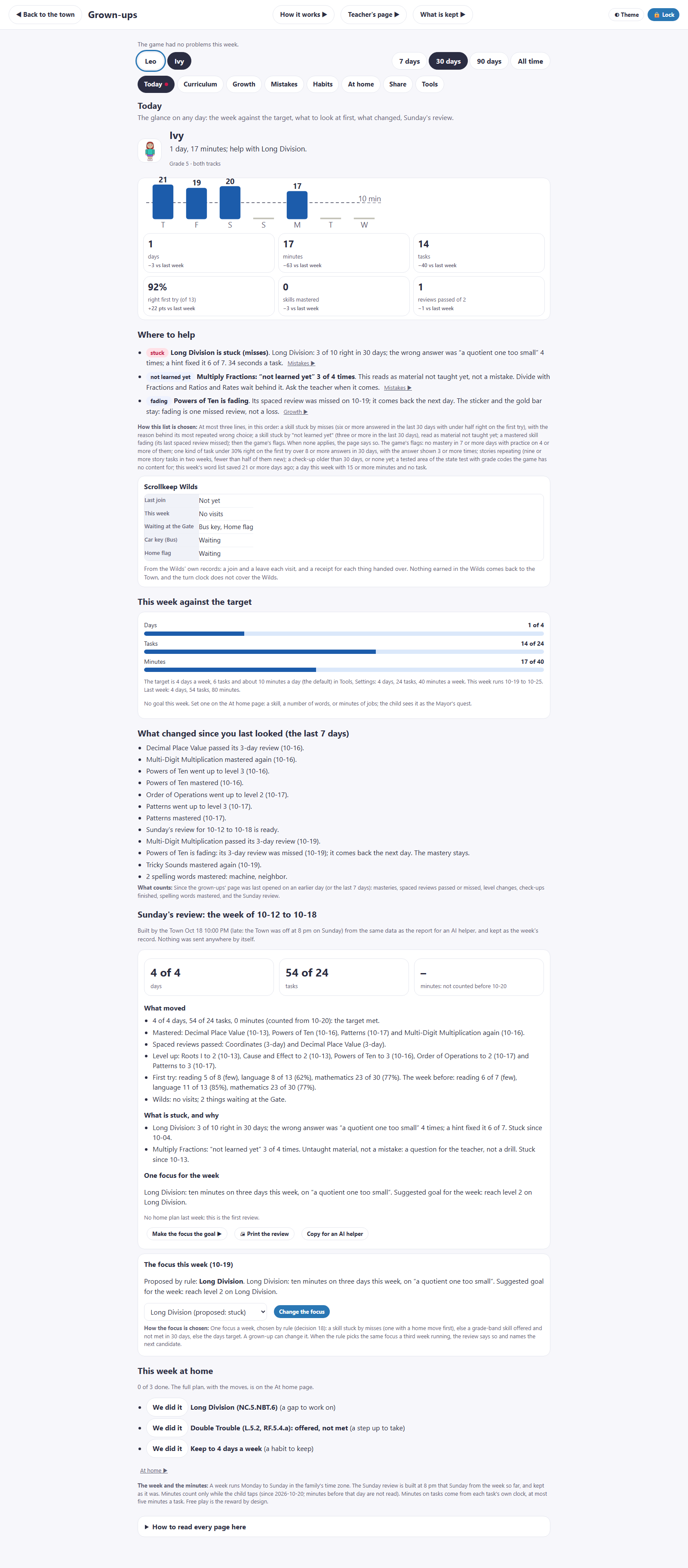
- Today. The week against a target you set (four days, six tasks and about ten minutes a day to start): days, minutes, tasks, right on the first try, skills mastered.
- Where to help. At most three lines. A skill stuck by misses, with the wrong answer named ("a quotient one too small, four times"). A skill marked "not learned yet", shown as a question for the teacher. A mastered skill that is fading.
- What changed. Since you last looked: level-ups, masteries, check-ups finished, words mastered.
- Sunday's review. Every Sunday evening the town writes a short review of the week and proposes one focus for the next one. You can change it.
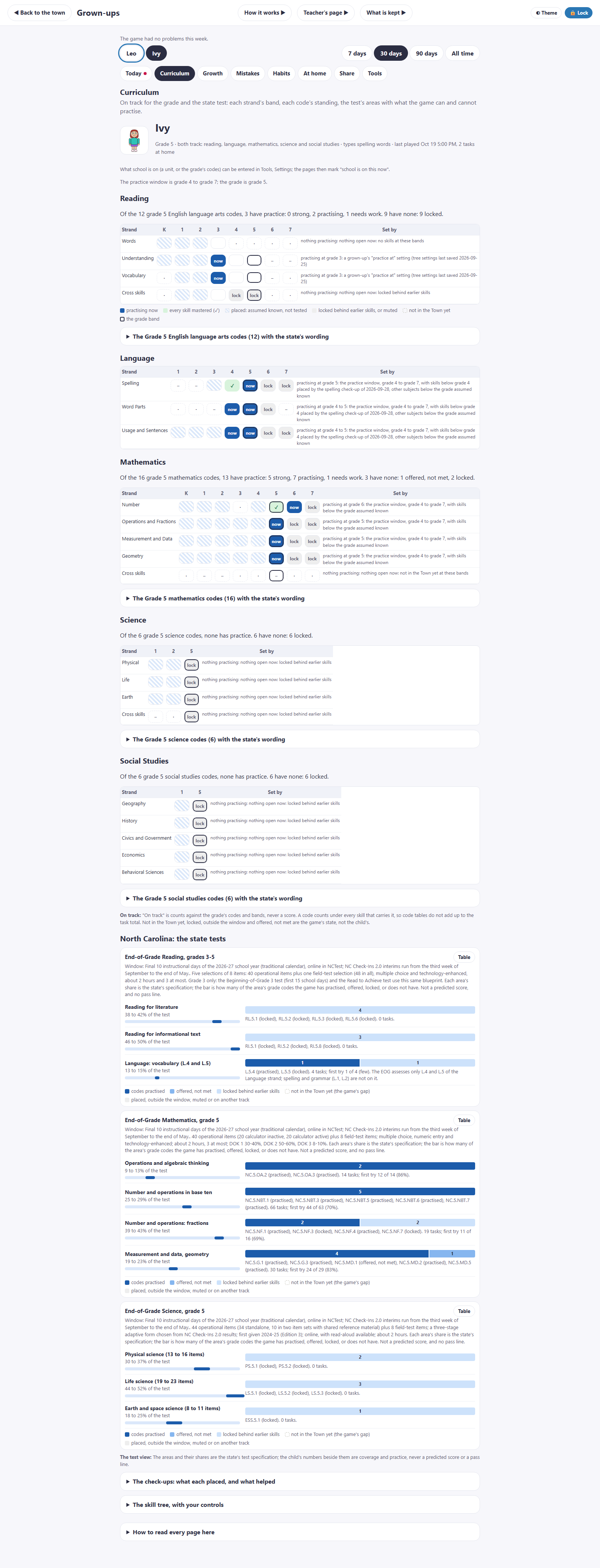
- Curriculum, Growth, Mistakes, Habits. The grade's standards with their standing, masteries over time, the most repeated wrong answers, and the days and minutes.
- The teacher's sheet. One printable page for a conference, with the standards in the state's own words.
- Share this week. Optional: one tap shares the week's summary from your iPad, only with whoever you pick.
Your hand on it
- Gifts. Send coins or a present to a child's mailbox.
- The weekly goal. A skill to reach, a number of words, or minutes of jobs. The child sees it as the Mayor's quest.
- The skill tree. Focus a strand, mute one, open one early, or set a reward on a skill.
- The turn clock. Minutes per turn, and the town says when it is time.
- Typing and read-aloud. On or off per child.
- Focus sessions. A grown-up picks a trouble spot from a plain list (for example past tense, ie or ei words, adding within 20), or one the town suggests from the wrong answers it has seen. Your child gets a letter from the Mayor: a short session of about ten minutes with a short check at the start, one lesson, practice that gets harder, and the same check at the end. You choose the prize (coins, or a reward of your own, like picking Friday's movie) and get a report: the check before and after, the mistakes that came up, and one next step. One session is a first sign, not proof that something is fixed.
Privacy
Nothing leaves the house unless you hand it over yourself: a backup file, Share this week, or the AI-helper report.
- No accounts, no sign-in, no email for a child.
- The town runs as an app on your family's iPad. Each child's progress is kept on that iPad. We never see it.
- Read-aloud uses the voices already on the device.
- No ads, no in-app purchases, no third-party anything in the app. The app's files come from a hosting service that sees what any website sees when you install or update; it never sees the children's records.
- "Download everything" gives you one file with all of it. "Start over (delete everything)" does what it says.
- Read-aloud uses the iPad's own voices by default; a grown-up can turn on online voices, and the app says what that sends.
Works offline at home
Yggy's Village runs as an app on your family's iPad, opened from an icon on the home screen. After the first open it works offline, with no accounts. Each child's progress is kept on that iPad, and a grown-up can download a backup file. The internet is needed only to install it and to get updates.
A grown-up sets it up once: each child's name and grade, and a PIN for the grown-ups' page. We will send plain instructions and help by email. The Wilds, the open world past the Gate, is a separate add-on that needs a home computer that can stay on.
What it is not
- Not a tutor, and not a replacement for school. It is practice with a report.
- Not test prep. The skills are tagged with the state's standards so the report can name them, but Yggy's Village makes no promise about grades or scores.
- Not a game that sells things. There is no store with real money in it, and there never will be one inside the town.
- Not finished. A few families get it first, and what they tell us shapes what comes next.
Ask us anything, then decide.
Join the waitlist and we will write when a place is ready. Replying to that email reaches a person.
Join the waitlist